We spent more than ten months preparing World’s Top Speakers in Armenia. At the time, it was the most challenging event project of my career: a major international speaker, hundreds of participants, partners, a team, sales, logistics, a venue, technical production, dozens of contractors, and hundreds of details, each of which seemed quite manageable on its own. Everything was proceeding as usual, plans were in place, tasks were being assigned, and deadlines were moving forward. Yet I constantly carried an unpleasant feeling inside me, familiar, I think, to anyone who has ever been responsible for a major event: the closer D-day gets, the more clearly you understand that you are far from in control of everything.
On October 28, we went to the airport to meet Brian Tracy. The first thing he asked for was one hundred grams of Armenian cognac. What could we do? It was Armenia, after all. We poured him some. We drank. Then another hundred grams. After that, everything comes back to me in fragments. I was in the second car, felt unwell on the way from the airport, and then seemed to black out.
I open my eyes and do not immediately understand where I am. There are some decorations, costumes, boxes, people running somewhere. For a few seconds, I try to reconstruct the sequence of events, then automatically look at the clock—4:30 p.m. At that moment, a chill runs through me.
“The very event we had spent more than ten months preparing. It had begun without me.”
At first, my mind clings to the simplest questions: who greeted the guests, who went on stage, what is happening at registration, where is the team, who is with Brian? A few seconds later, those questions stop mattering because another fear arrives—not organizational, but human. I picture the participants, partners, employees, people who entrusted us with their money, their name, their time. And over all of it, one thought: how will I look them in the eye now?
For a moment, a completely wild idea appears—to make it to the airport and simply disappear. Before anyone finds me. While I can still pretend that all this is happening without me. But somewhere ahead, I hear shouting. I walk toward it. And with every step, it gets worse.
For some reason, the stage is set right in the middle of a field. A strong wind is blowing. Handouts, participants’ notebooks, and loose sheets are flying through the air. People are ducking and holding advertising structures with their hands; they are about to collapse. It starts to rain. Brian Tracy is sitting on the stage—alone, without the familiar picture of a major business event, without any sense of order around him, simply Brian, a stage, and the wind tousling his hair.
And then, for a few seconds, hope rises inside me. Maybe we can still pull it together. Maybe this is just an unpleasant episode. Maybe in five minutes the team will take control of the situation, and afterward no one will even remember how badly it started.
I look at the front row. About twenty people are sitting at a huge set table in front of the stage. There is wine, vodka, shashlik, appetizers. One man shields himself from the rain with lavash and shouts to Brian: “Brian, we’ll take you away now, grandpa. Come sit with us, have a drink, have something to eat. We are not leaving—we paid 450,000.”
And this is where it becomes truly frightening. Because I no longer see simply a poorly organized event. I see a story that participants, partners, colleagues, competitors, and people I do not even know will be retelling tomorrow. A story that will outlive the event itself.
But my mind is still trying to find a way out. We need to move people away from the structures, find the team, save the equipment, put the stage in order, somehow finish the program. Something can still be done. And at that very moment, a powerful gust of wind lifts a huge press wall bearing our partners’ logos into the air.
I watch it turn over in the air, and suddenly everything inside me goes quiet. The panic disappears. One very simple, very clear thought remains: that’s it. Right now, before my eyes, my professional career is coming to an end. And most likely, I will have to go to the airport not alone, but with my family.
I bolted upright in bed. For a few seconds, I did not understand where I was at all. The room was quiet. A bed beside me. Home. No field, no rain, no press wall flying through the air. I looked at the clock—it was 5:55 a.m.
I was at home, in my own bedroom. Brian Tracy had not even arrived in Armenia yet. Exactly fifty days remained before the event. It was a dream.
But my body did not understand that yet. My heart was pounding as if it had all just happened in real life. I sat on the bed and, for the first time in all the months of preparation, saw the project as a whole—not as a beautiful presentation, not as a schedule, not as a set of cards in a task-management system, but as a living structure in which dozens of things depend on one another and can collapse not one by one, but in a chain. From that morning on, World’s Top Speakers in Armenia became a different project for me.
Until then, we had everything a properly managed major project is supposed to have: Trello, Wrike, spreadsheets, owners, deadlines, statuses, calls. Every task existed somewhere, every one had an assignee, every one had a due date. On screen, it all looked quite convincing. But after that dream, I suddenly felt one unpleasant thing very clearly: the fact that a task exists in the system does not mean it is truly under control. Sometimes the opposite is true. As soon as a task gets a card, a status, and an owner, the mind starts to regard it as almost solved. It becomes reassuring, stops causing concern, and it is precisely such reassuring tasks that can prove the most dangerous.
I took a large ledger notebook and began rewriting the entire project by hand every morning. Not reviewing it, not moving cards from one column to another—rewriting it, again and again. At first, it looked almost absurd: a modern project, dozens of people, digital tools—and there I was, sitting with a thick notebook and a pen. But I understood very quickly why it worked. When you write out the same unresolved task anew every day, it cannot hide behind a green status. You ask yourself again: who is working on it, why is it still not closed, what happens if that person does not make it, is there a backup, who will take over, what else depends on this decision? Gradually, the list stopped being a list. A map of interdependencies appeared before me.
“The most dangerous tasks in a major event project often look completely calm. They have a deadline, an owner, and a status. The problem begins when the entire team is certain that the issue is already under control.”
For the next fifty days, I woke up at roughly the same time—5:55. And this is when the emotional swings began, the very ones I would later notice again and again in work on major projects. One day, you look at the system and think: everything is fine; we are following the plan. The next day, you spot one weak point and can already see in your mind the chain of problems growing from it. Then you find a solution, and the picture becomes stable again. Two days later, a new risk emerges, and you return once more to the bad future to ask yourself again: what could go wrong here?
In essence, I was living between two versions of the event the entire time. In one, Brian arrived in Armenia, the hall was full, participants received what they came for, partners were satisfied, the team was proud of its work, and we watched the final video knowing those ten months had been worth it. In the other, the wind blew, structures fell, participants shouted, partners watched the press wall flying through the air, and I stood in the middle of a field understanding that it was already too late to fix anything. And it was the constant movement between these two pictures that made the project stronger.
Because a good future teaches little on its own. It is pleasant, motivating, energizing. But a bad future asks much more useful questions. What happens if the speaker is delayed? What if the contractor does not arrive? Who makes the decision if communication is lost? What do we do if the person holding an important area together suddenly drops out? How quickly will the team understand that the problem has already begun? Where is our single point of failure that everyone knows about but no one seriously discusses? From the outside, you might call it pessimism. For the person responsible for an event, it is simply another way of designing.
Until the event begins, a bad scenario remains a gift. It can be changed.
“Fifty days before an event, almost any risk is still a question. On the day of the event, it becomes a fact.”
That is probably why I did not go to the airport on the day Brian arrived. Formally, that was exactly where I was supposed to be: the project founder, the keynote speaker, the greeting, the photograph, the handshake. All beautiful and proper. But by then, I understood very well that my value at that moment was not in a beautiful shot. I needed to be where dozens of processes converged. Brian could be met without me, but some decisions within the project still required my attention. It is one of the things I would remember many times afterward: in major projects, a leader constantly has to choose between the place where people expect to see them and the place where the result truly depends on them. Very often, those are different places.
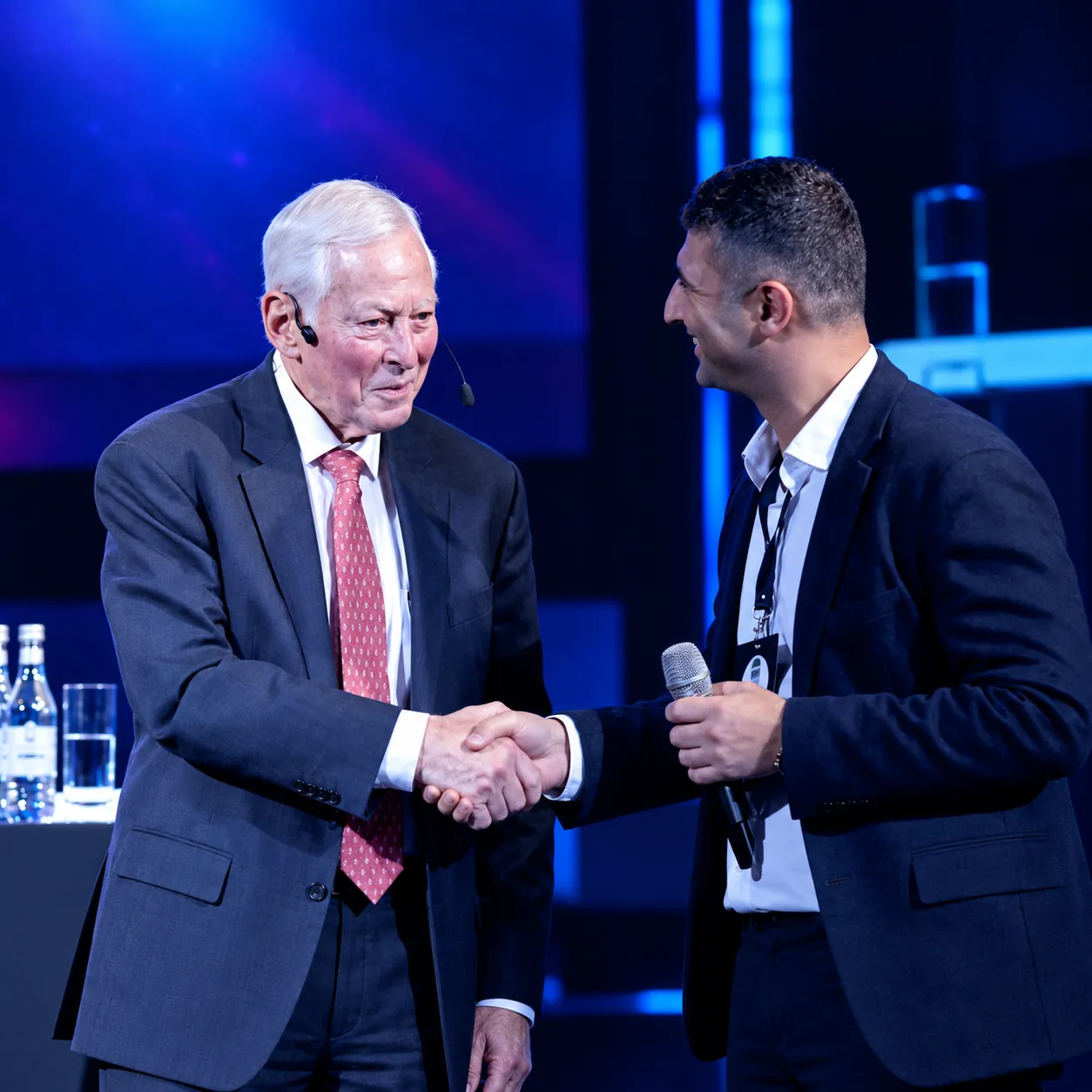
Fifty days later, Brian Tracy did indeed arrive in Armenia. World’s Top Speakers in Armenia took place. There was a full hall, a stage, participants, partners, a team—everything we had imagined for many months finally became reality. In the final three-minute video, it all looks easy. That is how a good event usually looks: the audience sees the lights, the stage, the speaker, people’s emotions. They should not see the late-night calls, backup plans, dozens of double-checks, revised layouts, and hundreds of decisions that made that picture possible in the first place. There is a strange paradox in our profession: the better the work is done, the less of the work the person in the hall notices.
Years later, I began to see that story very differently. Back then, I thought I had simply had a very bad dream. Now I think my mind gave me one of the most useful strategic sessions of my life. It showed me the bad future so vividly that, after waking up, I could no longer look at the project through the same eyes.
Since then, I have had projects far larger, more complex, and more expensive. Stronger teams emerged, along with more mature processes, different management systems, and different scales of responsibility. But one habit remained. When a project becomes truly important, I sometimes deliberately imagine its bad day: not a fantastic catastrophe, not an apocalypse, just a realistic scenario in which several things fail at once. What would have to happen for the system to start falling apart? Where is our one weak link? Which person is carrying too much? Which task did we stop checking long ago? Which risk seems so unlikely that no one is dealing with it precisely for that reason?
Then I return in my mind to today. Because that is where the main advantage lies: time. There are still fifty days before the event, and almost everything can still be changed.
A major event is very rarely saved by heroic actions at the last minute. Much more often, it is saved by boring decisions made in advance: someone asked an uncomfortable question in time, someone checked a second scenario, someone found a backup, someone walked through the entire journey once again through a participant’s eyes, and someone stayed to work instead of going to the airport for a beautiful photograph.
Sometimes professional event management begins with a grand strategy. Sometimes, with a simple notebook. And sometimes with waking up at 5:55 a.m. after a very bad dream and suddenly understanding one important thing: the worst has not happened yet. And that is exactly why you still have a chance to do everything right.