When I look at a major event, I quickly become less interested in whether it looks impressive. Visual impact is an outcome. What interests me is the architecture that produces it: the business objective, the central idea, the environment built around it, the guest experience, the engineering decisions, the stakeholders beyond the guest list, and what continues to work after the venue is empty.
Louis Vuitton Men’s Spring–Summer 2027 is an unusually useful case for that kind of analysis.
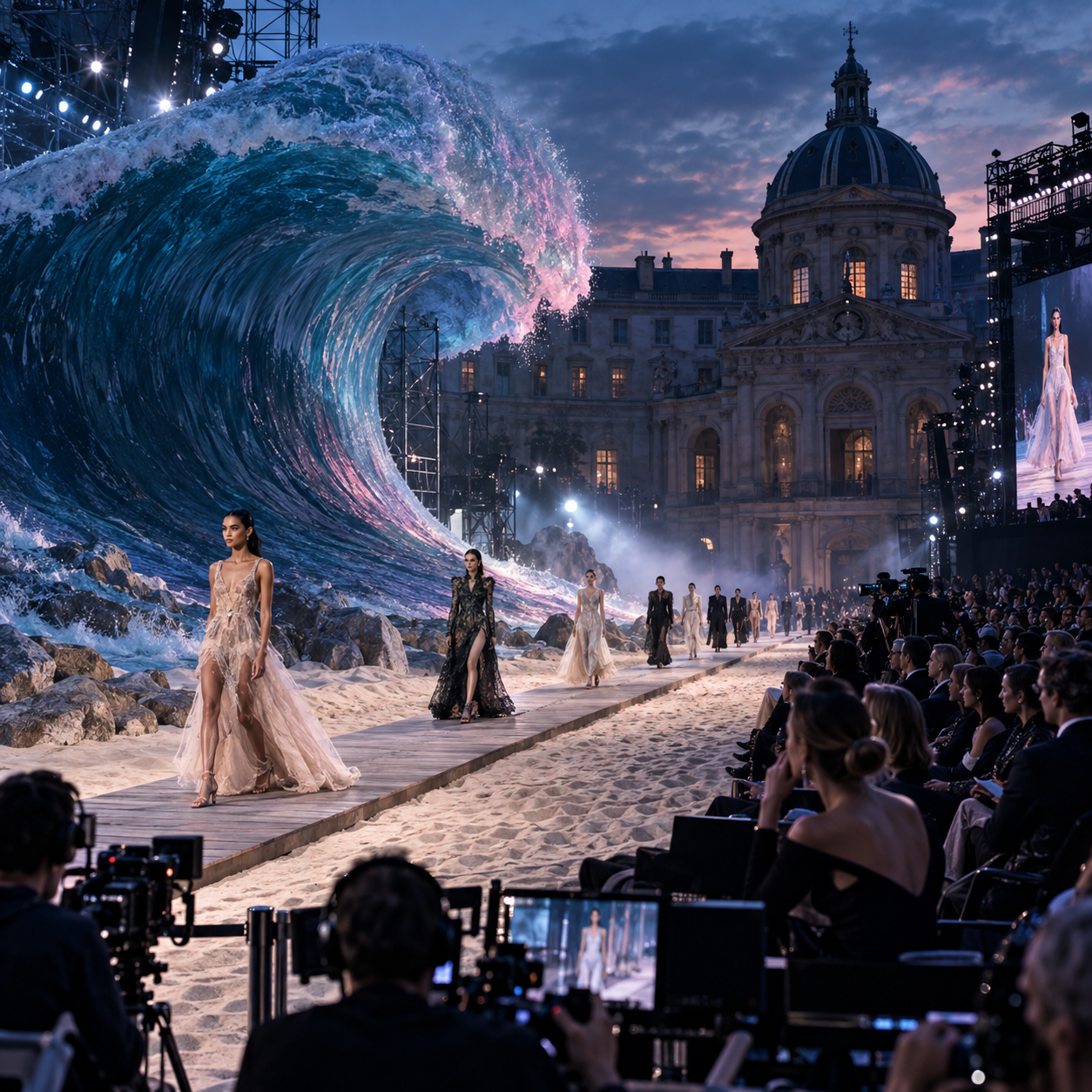
The official story is compelling. Pharrell Williams brings together the codes of the dandy and surf culture; a university campus in Paris is transformed into a coastal environment; real sand covers the ground; water comes from the Paris municipal system; and the collection extends the same vocabulary of sea, movement, travel, performance and savoir-faire.
But useful Event analysis begins where the press release ends.
“If all we see is the wave, we are seeing less than half of the event.”
A powerful image needs a job to do
The first mistake in analysing an event like this is to begin with the set. I prefer to begin with the problem the event is designed to solve.
For Louis Vuitton, several layers were operating simultaneously.
The first was brand. A global luxury fashion show is no longer simply a presentation of clothes to buyers and media. It is a proprietary media platform. It has to reinforce cultural relevance, create the visual language of a season and produce images that can travel far beyond the physical venue.
The second was product. Williams’ collection was built around the meeting of the dandy and the surfer: precise tailoring alongside technical materials, wetsuit references and surf and skate codes. The wave therefore had a strategic relationship to the collection. It gave the product a world in which to exist.
The third was attention. Every physical venue has a capacity limit. The media capacity of an event does not.
That distinction matters enormously in contemporary Event marketing. We are designing both the experience inside the venue and the mechanism through which the event travels afterwards: what will be photographed, what can be understood in a single frame, what survives without explanation and which element can become an independent media asset.
In that sense, the wave was exceptionally efficient. One image already communicated scale.
From set design to environment
The show was built as an environment rather than as a neutral runway with decoration added to it.
Sand, the monumental wave, the boardwalk-like path, a reflective camper van, music and cinematic surf imagery established the world before the collection had fully unfolded.
This is an important professional distinction.
A set sits in front of a guest.
An environment changes the guest’s position inside the event.
The audience was not simply looking at a representation of the coast. The architecture, materials, sound and movement placed them inside a coherent narrative.
That is where Event design becomes more interesting than scenography. The question changes from “What should we put on the stage?” to “What state should the person experience, and which decisions will create that state together?”
“A strong Event concept does not live in the decoration. It lives in the consistency of decisions.”
The wave, sand, runway, music, film, clothing and surf culture spoke the same language.
That coherence is much harder to achieve than visual scale.
The simpler the experience looks, the more complex the system underneath it
For a guest, the wave appears instantly.
For the team, it begins weeks earlier.
The installation occupied the site for roughly six weeks. The venue was the Cité Internationale Universitaire de Paris, a residential university campus associated with the daily lives of around 12,000 students.
Water came from the Paris municipal system and circulated through a closed-loop arrangement before returning to the city network. The sand was designated for further use after the event.
Once the fashion, celebrity presence and Louis Vuitton name are removed, what remains is a demanding temporary-infrastructure project inside a functioning residential environment.
Materials have to arrive. Structures have to be erected and removed. Water, electricity, guest movement, security, show operations, access, sound and emergency planning have to coexist.
Afterwards, the site has to return to normal.
And the guest should notice almost none of this complexity.
“The easier an event feels to the guest, the more complexity someone has already resolved on their behalf.”
This is where the profession really begins: within dozens of interconnected decisions where changing one parameter reshapes several others.
This systems view is also one of the areas we work through using the EMBOK framework in PROEvents360: the event is considered as a connected system of objectives, stakeholders, risks, communications, operations and project decisions. The Louis Vuitton case is valuable because those dependencies are unusually visible at global scale.
The most important problem was outside the guest list
This is where the case becomes genuinely instructive.
An event can be meticulously designed for invited guests while under-designing the experience of everyone else affected by it.
The Cité Internationale Universitaire de Paris is a residential environment. Some students complained about restricted access and disruption during the preparation period. With temperatures exceeding 40°C, the visual symbolism of a giant water installation also attracted criticism.
The institution had another legitimate perspective: Louis Vuitton’s partnership also represented financial support at a time of reduced public funding and rising costs.
Both realities can exist at the same time.
For the brand and venue management, the project represented partnership, resources and a global cultural moment.
For some residents, it meant weeks of changes to the place where they lived.
That leads to one of the most important lessons in the entire case.
“Permission to stage an event is not the same as consent from everyone whose life the event changes.”
Every large event has stakeholders beyond its audience: residents, employees, venue communities, neighbours, authorities, city services and partners.
The more strongly an event intervenes in their normal environment, the earlier stakeholder work has to begin.
This is Event architecture too — the architecture of relationships.
Sustainability is also a communications problem
Louis Vuitton incorporated several concrete sustainability measures into the project.
Water operated within a closed system. Sand was given a further use. Elements of the scenography were reused. The Maison also connected the show to its Regeneration 2030 programme and its support for Coral Gardeners, including reef-restoration activity in French Polynesia.
Operationally, these are meaningful decisions.
But events exist in both physical and symbolic reality.
Technically, the water can circulate through a closed system. Visually, the public still sees an enormous wave during an extreme heat event.
Both facts are true.
This creates an important management principle: responsible design must also be legible. If stakeholders do not understand the logic of a decision, the technical reality of the project and the public interpretation of it begin to diverge.
Communication therefore has to begin before explanation becomes defence.
An event outlives its schedule
The show itself was short. Its consequences were not.
For fashion media, the event became part of the story of Louis Vuitton Spring–Summer 2027 and Pharrell Williams’ evolving creative direction.
For social media, it became the wave.
For Event professionals, it became a case in temporary architecture and production.
For the campus community, it became part of a discussion about access, disruption and the relationship between luxury brands and shared urban space.
For the sustainability debate, it became an argument about the difference between technically responsible production and public perception.
For Louis Vuitton, all of those narratives became part of the brand.
This is why I am cautious whenever someone asks how long an event lasted. The programme provides only one answer.
The strategic duration of an event is the length of time it continues to create attention, memory, content, relationships and consequences.
“An event ends for the guest long before it ends for the brand.”
What Louis Vuitton did particularly well
The strength of this show was not the height of the wave.
A larger installation would not automatically have produced a stronger event.
Louis Vuitton achieved a high degree of alignment between the strategic idea of the collection and the decisions surrounding it.
The dandy-surfer concept continued through clothing, space, materials, water, music and film. The scale of the set created a global media asset without completely overwhelming the product itself.
That balance is relatively rare.
The weakness appeared elsewhere. The system was deeply designed around the brand, product and guest experience, while engagement with part of the surrounding community proved less convincing.
That combination of success and tension is precisely what makes the case useful.
Perfect case studies teach very little.
Real systems teach much more.
Four questions instead of four lessons
After a project like this, I am less interested in producing a checklist of things other brands should copy.
Large events are rarely transferable at the level of execution. They are much more useful as material for better questions.
What business and brand objective is the central image actually solving?
Does the core idea continue through space, programme, movement, content, communications and operations?
Who is affected by the event beyond the guest list — who benefits, who absorbs inconvenience, who carries risk, and who can influence public interpretation?
And what remains after dismantling: materials, data, relationships, content, reputation, a stronger community, a commercial opportunity — or only photographs?
Those questions travel much better than an eight-metre wave.
After the hype
The longer I work with events, the more accurate one phrase feels:
“Hype ends. Event architecture remains.”
Hype concentrates attention on the visible result.
The profession requires us to examine the system.
The Louis Vuitton wave was spectacular. By itself, it teaches very little.
The useful case begins when we see the six weeks before it, the people around it, the operational constraints beneath it, the brand decisions inside it and the consequences that remained after dismantling.
That is the point at which an event stops being an image.
It becomes architecture.